
Senior Capstone Projects

Senior capstone projects give students the opportunity to design solutions to real-world problems with guidance from faculty, researchers, or industry mentors. Working in teams of three to four, students identify a need, develop a proposed solution, and refine their experimental approach or prototype throughout the semester.
The capstone experience includes:
- Project development: Teams identify a problem, define project goals, and develop an experimental protocol or prototype.
- Mentorship: Students meet with their faculty, research, or industry mentors every two weeks and provide monthly progress reports.
- Hands-on project work: Students dedicate approximately 15 hours per week to their projects over the 12-week semester.
- Final deliverable: By the end of the semester, teams produce a preliminary solution or a set of analyzed and contextualized data that demonstrates the results of their work.
Please contact Assistant Teaching Professor Angela Lai at angela.lai@tufts.edu if you are interested in mentoring a team or are a student with questions about the capstone.
Course Options
-
The Research Capstone is a two-semester course sequence built around an open-ended research question. Students develop an NIH-style research proposal, define and carry out an experimental approach, and complete a final paper structured in IMRAD format.
-
The Design Capstone is a one-semester course offered in the spring and centered on an open-ended design problem. Students develop project deliverables that may include CAD drawings, a traceability matrix, and a design verification or validation protocol.
Spring 2026 Projects

Design and Validation of a Modular Frequency-Domain NIRS Headset for Stable Cerebral Monitoring
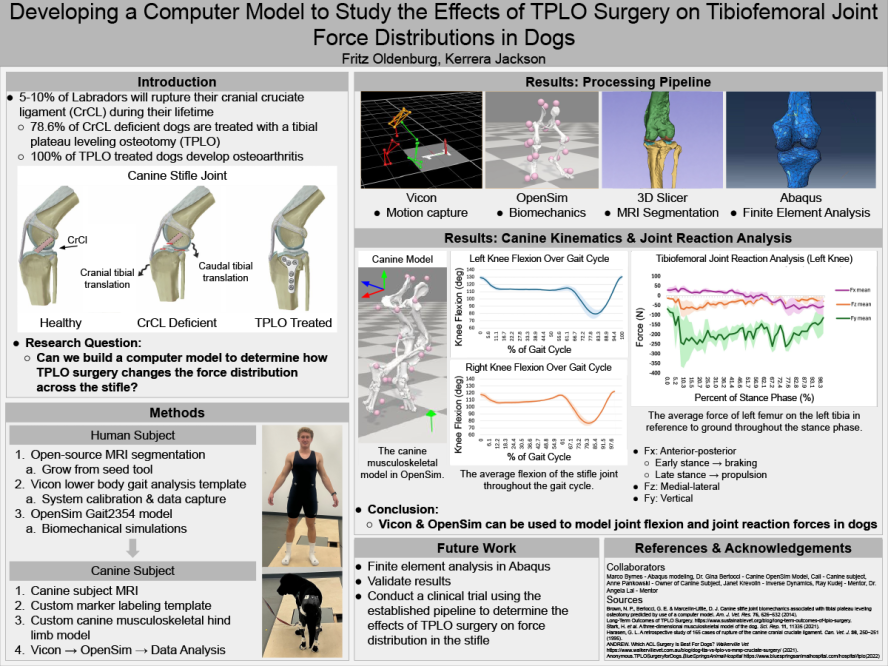
Developing a Computer Model to Study the Effects of TPLO Surgery on Tibiofemoral Joint Force Distributions in Dogs
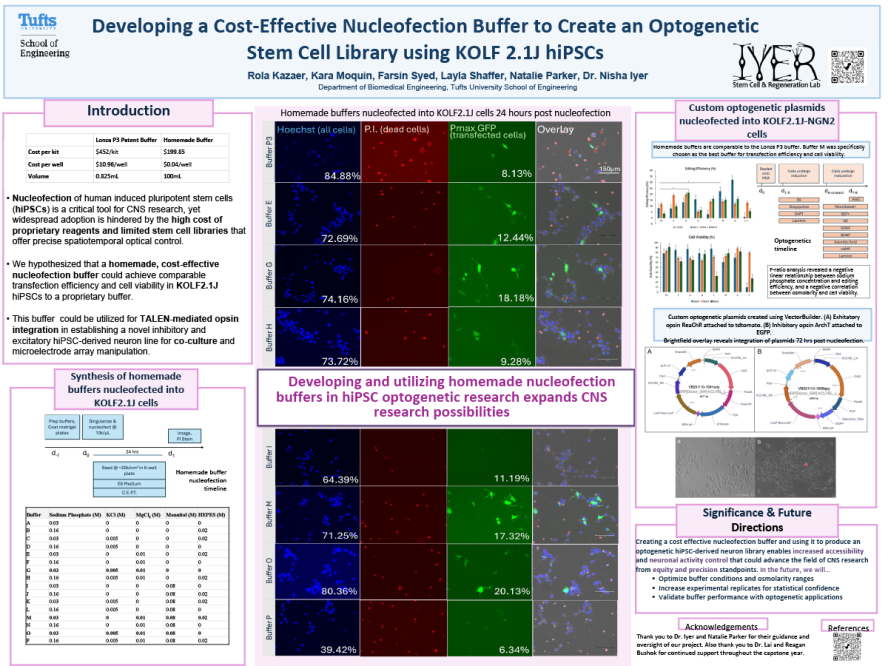
Developing a Cost-Effective Nucleofection Buffer to Create an Optogenetic Stem Cell Library Using KOLF 2.1J hiPSCs

Developing a Denture Mastication Platform for Studying Denture-Induced Oral Conditions

Development of Economically Viable Plant-Based Edible Microcarriers for Large-Scale Cell Cultivation

Hydrogel Microneedle Platform for Point-of-Care Monitoring of Metabolic Syndrome Biomarkers

Investigating the Role of the Tumor Extracellular Matrix in Regulating Triple-Negative Breast Cancer Response to Chemotherapy

Macrophages Exhibit Enhanced Regenerative and Proliferative Activity in Neonatal cECM-Based Hydrogel Models

Micropillar-Guided Alignment of Cardiac Fibroblasts in 3D Fibrin-ECM Constructs
