4th Annual Symposium in Geotechnical Engineering

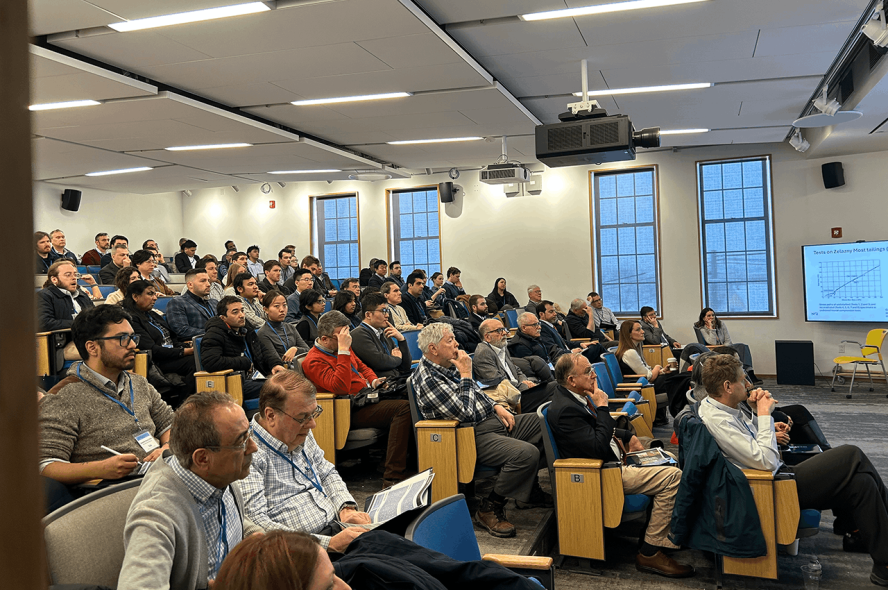
The Department of Civil and Environmental Engineering at Tufts University was proud to host the 4th Annual Tufts Geotechnical Symposium on February 7, 2026. The theme, Reconciling Laboratory Testing, Numerical Modeling, and Field Applications in Geotechnical Engineering, highlighted the ongoing challenge of connecting experimental insights and computational advances to practical, field-scale geotechnical solutions. The theme carries special significance as it honored the life and legacy of Dr. Juan Pestana, a globally recognized leader in soil behavior, constitutive modeling, and numerical methods.
Saturday, February 7, 2026 | 8:00am - 5:00pm
Robinson Auditorium, Room 253, Tsungming Tu Complex (TTC),
200 College Ave, Medford, MA 02155
The symposium welcomed all professionals from academia, industry, and government agencies engaged in policy, regulation, and performance evaluation of geotechnical systems. Registration fee included admissions to seminar, breakfast, lunch, and afternoon break. Registration fee was $10 for students, $25 for government employees, $50 for university employees, and $100 for engineers and contractors.
Call for Submissions
Those interested in presenting at the symposium were encouraged to submit 1-page abstracts for potential oral presentations or posters to Professor and Louis Berger Chair Farshid Vahedifard (farshid.vahedifard@tufts.edu) by January 15, 2026.
Symposium Goals
The symposium aimed to provide a dedicated venue for the geotechnical community to advance dialogue on how laboratory testing and numerical modeling can be effectively integrated to inform and improve field applications. This year’s theme was particularly meaningful, as it is closely aligned with the pioneering contributions and lasting legacy of Dr. Juan Pestana.
Honoring Dr. Juan Pestana
Dr. Pestana was a Professor of the Practice in the Department of Civil and Environmental Engineering at Tufts University, Professor Emeritus at UC Berkeley, and a Senior Principal with Geosyntec Consultants. A innovative researcher and dedicated educator, he shaped the field of geotechnical engineering through his work on soil behavior, constitutive modeling, and numerical methods, while inspiring generations of students and practitioners worldwide.
Alongside showcasing research and case studies that bridge laboratory data, constitutive modeling, and field performance, the symposium also honored Dr. Pestana’s life, work, and profound influence on the field and its next generation.

Symposium Overview
This year’s theme, Reconciling Laboratory Testing, Numerical Modeling, and Field Applications in Geotechnical Engineering, highlighted the ongoing challenge of connecting experimental insights and computational advances to practical, field-scale geotechnical solutions. The symposium provided a forum to discuss how laboratory testing methods, state-of-the-art constitutive modeling, and advanced numerical tools can be integrated and validated through case histories, monitoring, and performance evaluation of real-world infrastructure.
Geotechnical engineering has long relied on laboratory testing and numerical modeling as complementary methods for understanding soil and rock behavior. However, challenges remain in translating laboratory-scale findings into field-scale performance and reconciling model predictions with observed behavior in complex, real-world conditions. With growing demands for resilient and sustainable infrastructure under climate change and urban expansion, the ability to effectively integrate laboratory insights, numerical tools, and field performance data is more critical than ever. This year’s symposium explored these challenges and opportunities, focusing on how advances in laboratory testing and constitutive modeling can be used to calibrate and validate numerical models, and how these models can, in turn, extend laboratory findings to predict large-scale geotechnical behavior. Presentations highlighted case histories where integrated approaches have informed design, monitoring, and rehabilitation, while also addressing the limitations, uncertainties, and future needs in bridging the gap between research and practice.
The symposium brought together faculty, students, practicing engineers, consultants, and representatives from state and federal agencies. By creating a forum for knowledge exchange across academia, practice, and policy, the symposium strengthened the connection between research and application and promote innovations that support safer, more resilient, and more equitable geotechnical systems.
Key topics explored include, but were not limited to:
- How advanced laboratory testing can generate high-quality data to calibrate and validate constitutive models.
- Ways in which numerical modeling can extend laboratory findings to predict performance under field-scale and multi-physics conditions.
- Case studies where integrated laboratory–numerical approaches have successfully informed the design, monitoring, and rehabilitation of geotechnical infrastructure such as dams, levees, transportation systems, and offshore foundations.
- Challenges and opportunities in reconciling discrepancies between laboratory behavior, numerical predictions, and observed field performance.
- The role of emerging technologies, including AI, data-driven modeling, and sensor-based monitoring, in linking lab-scale characterization with predictive field applications.
- How integration of laboratory testing and modeling can improve resilience, sustainability, and equity in geotechnical practice.
Over the years, the symposium has expanded, drawing participants from a diverse range of regional and national sectors, including academia, state and federal agencies, and private industry. It has established itself as a key platform for knowledge exchange, fostering discussions on emerging trends and challenges in geotechnical engineering, particularly among the geotechnical engineering community in the Greater Boston area and the Northeast region. Additionally, the symposium has provided invaluable professional networking opportunities for students and early-career professionals, enabling them to engage with experts and industry leaders and helping to bridge the gap between academia and practice.