Past Spotlights on Mechanical Engineering

2025
Student highlight
Name: Claudia Bird
Degree: MS and PhD in Mechanical Engineering
Faculty lab: Professor Luisa Chiesa
Hometown: Oroville, CA
Why Tufts?
My undergraduate experience in a superconducting magnet research lab excited me and motivated me to pursue a PhD. When I was searching for graduate programs, I learned of Dr. Chiesa's superconductivity lab and Tufts quickly became my top choice. As a current graduate student, Tufts' broad range of research, culture of collaboration, and academic rigor have confirmed that I am in the right place.
Favorite thing about living in the Medford/Somerville and Boston area?
It's hard to pick just one, but if I had to choose, I'd say my favorite thing is immersing myself in the rich history of the area. Living in the greater Boston area allows me to delve deeper into American history within its context.
Any advice you’d give to prospective students or new graduate students?
My suggestion for prospective students is to find programs or research topics that excite them! Part of the value a student gains from their program is directly related to the enthusiasm they bring and how they apply it. For new graduate students, I suggest they use the resources Tufts has to offer.
Faculty highlight

Name: Professor Luisa Chiesa
Research interests: Sustainable energy, superconducting materials, materials science
About Professor Chiesa:
Luisa Chiesa’s primary research interest is superconducting materials for large powerful magnets to be used in particle accelerators, medical devices, and fusion energy machines. Her current research focus is the electro-mechanical behavior of superconducting materials for large magnets used in fusion power devices. Fusion reactors could play a key role in the power production of future generations. This research is also of interest for other energy applications, such as superconducting magnetic energy storage (SMES) and superconducting transmission lines. These technologies could play a significant role in power storage and delivery, which are the backbone for the successful implementation of renewable energy sources. As these energy sources (solar and wind, in particular) are inherently intermittent, efficient ways of storing and delivering energy are necessary components to improve their reliability. The measurements performed in Chiesa's laboratory are unique and focus mainly on superconductors, but the equipment available can be used to test different categories of materials.
2023

Student highlight
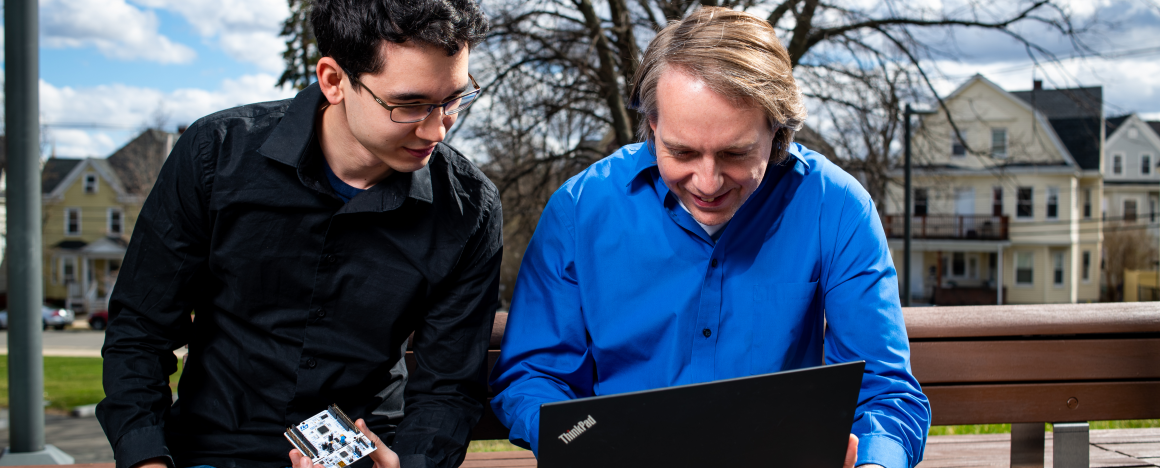
Name: Tim Cheng
Degree: MS and PhD in Mechanical Engineering
Faculty lab: Associate Professor Robert White
Hometown: Guilford, CT
Why Tufts?
I enjoy a smaller school with a diverse set of majors; it really promotes the mingling of knowledge between many fields. So when Professor White approached me with an interesting project that mixed acoustical, electrical, and mechanical aspects together, I was all in.
Favorite thing about living in the Medford/Somerville and Boston area?
Living on the outskirts of Boston, I really get the best of both worlds when it comes to urban and forest environments. One day can be a visit to a world class museum and the next a secluded jog by a wooded lake.
Any advice you’d give to prospective students or new graduate students?
Use the vast resources on campus — talk with professors outside of class, set a personal record in the gym, make a gizmo in the machine shop. Your education is not limited to coursework or just what is in your major.
Faculty highlight
Name: Associate Professor Robert White
Research interests: Microelectromechanical systems (MEMS) fabrication, modeling, and testing, acoustic MEMS (microphones, ultrasound), and aerodynamic measurement technologies (skin friction sensors, aeroacoustic sensors).
About Professor White:
Robert White’s core expertise is in acoustic microsystems, microfabrication/MEMS, biomimetic sensing, modeling and design of sensors, and vibro-acoustic experimental techniques. He has been working on microfabricated devices since 1996 and has been with the Department of Mechanical Engineering since 2005. He runs a research group working at the intersection of micro- and nano-scale devices, acoustics, sensors, and aerodynamics.
He is also the founding director of the Tufts Micro- and Nano-Fabrication Facility, which first opened to the Tufts community in 2007. His research interests are directed towards device development and engineering science in micro- and nano-technology, with an emphasis on acoustic sensing, wind tunnel instrumentation, aerodynamic measurements, dynamic systems, and robotic systems.
2022

Student highlight
Name: Brandon Weaver
Degree: M.S. in Mechanical Engineering
Faculty lab: Professor Jason Rife, Automated Systems and Robotics Lab
Hometown: Alabaster, AL
Why Tufts?
I chose Tufts because I wanted to work with Jason Rife and [Professor of the Practice] Pratap Misra doing GPS work, and both of them being in the Mechanical Engineering department was a bonus.
Favorite thing about living in the Medford/Somerville and Boston area?
The main things I like about living here is the history that surrounds the Boston area as well as how walkable it is.
Any advice you’d give to prospective students or new graduate students?
Consider not bringing a car! Almost three years living here and I haven’t missed mine.

Faculty highlight
Name: Professor and Department Chair Jason Rife
Research interests: Navigation, robotics, and controls.
About Professor Rife:
Jason Rife's research focuses on the navigation and control of autonomous vehicles and mobile robots. He joined the Tufts Department of Mechanical Engineering in 2007. Prior to arriving at Tufts, he served as a research associate in the Stanford University GPS Laboratory from 2004-2007, where he investigated the integrity of precision aircraft approach and landing systems based on differential GPS. He received his Ph.D. from the Stanford University Aerospace Robotics Lab, studying animal-tracking applications using underwater robots.
Read more about the Automated Systems and Robotics (ASAR) Lab!