Spotlight on Civil and Environmental Engineering

Student highlight
Name: Hooman Shirzadi
Degree Program: Ph.D. in Civil and Environmental Engineering
Faculty Lab: Geohazards Research Lab (Professor and Chair Laurie Baise)
How has your time at Tufts impacted your career?
My time at Tufts has been transformative. It has allowed me to transition from a student to an independent researcher. Working with Professor Baise and Professor Moaveni in the Civil and Environmental Engineering (CEE) department has expanded my professional network and sharpened my ability to communicate complex technical concepts to both academic and industry audiences.
Why Tufts?
Tufts offered a unique combination of high-level research and a supportive community. The Department of Civil and Environmental Engineering (CEE) has faculty members with deep expertise in my areas of interest, providing an ideal environment for collaborative mentorship. Additionally, Research and Teaching Assistantships provided the financial stability I needed to focus on my Ph.D. Beyond academics, the Greater Boston area offers a vibrant intellectual atmosphere, while still being close to the incredible outdoor activities—like skiing and hiking—that the Northeast is known for.
What are you researching?
My research focuses on developing advanced machine learning and statistical models for natural hazard modeling, structural dynamics, and health monitoring. Specifically, I work on quantifying uncertainties and improving the resilience of infrastructure against seismic-related risks. By integrating system identification and Bayesian modeling, my goal is to create smarter, safer environments.
Best course you’ve taken at Tufts?
The Machine Learning course bridged the gap between raw data and engineering insights. It gave me a profound understanding of how these models function "under the hood," focusing on the rigorous mathematical background and optimization theories that drive them. It gave me the critical thinking skills to adapt and develop new models specifically tailored for complex challenges in structural health monitoring and natural hazard modeling.
What are your career goals?
My career goal is to continue contributing to the field of civil engineering through research and development, whether in an academic setting or within a private-sector innovation lab. Tufts is helping me reach these goals by providing the computational resources, funding, and mentorship necessary to publish high-impact research and build a competitive professional profile.
Faculty highlight: Professor and Chair Laurie Baise
Research interests: Geotechnical earthquake engineering, seismic hazard mapping, natural hazards
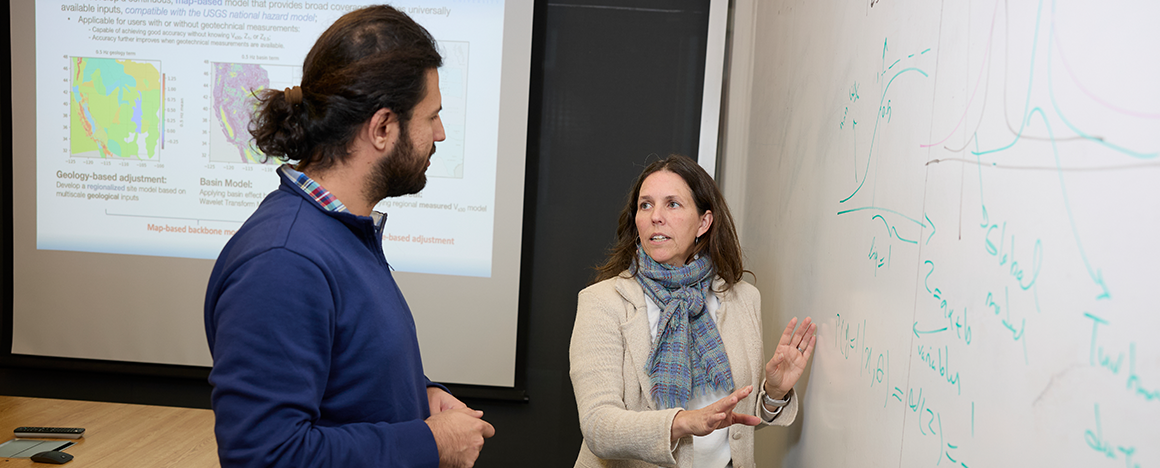
Professor and Chair of the Department of Civil and Environmental Engineering Laurie Baise's work in the Geohazards Research Lab addresses hazards such as earthquakes and extreme wind, and links predictive models with observational data. She is an expert in earthquake site response and regional seismic hazard mapping. Baise's recent research focuses on regional mapping for rapid response and loss estimation. Baise and her students are interested in both developing predictive models to predict damage extent and using remotely sensed imagery and automated classification techniques to develop damage extent maps immediately following natural hazard events.