Do You Trust AI?

When it comes to emerging technologies like AI, how can people listen to others with an open mind and think collectively about developing AI for the public good? The Civic Innovation Initiative at the Auster Center for Applied Innovation and Research is addressing this question head-on with a new initiative focused on trust in AI.
Through candid conversations with an interdisciplinary group of people interested in AI, the Auster Center’s first research initiative aims to understand and address the broader hopes and concerns that people have around AI. The Auster Center’s inaugural Faculty Fellow, Professor Jonathan Garlick, and a planning committee kicked off the initiative with a recent brainstorming event to generate ideas for future research funding studying “Trust in AI”.
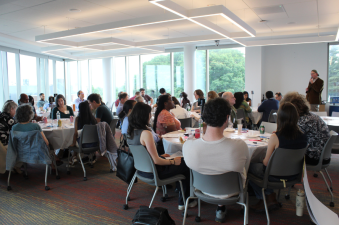
The event brought together educators, healthcare workers, students, industry members, community leaders, and researchers with a broad range of perspectives and experiences with AI. The committee’s careful planning and thoughtful engagement with how new technology impacts many areas of society resulted in an event where participants felt safe enough to share nuanced—and sometimes conflicting—opinions about AI.
“We invited participants to reflect on their own relationship with AI, and to consider, with curiosity and empathy, the perspectives and beliefs that others hold, so they can openly discuss how AI is playing a role in their lives.” said Garlick. According to Garlick, one goal was to “think more collectively at a time when people seem to be focused on how AI is impacting them personally.”
The committee curated a series of questions spanning from personal to societal dimensions. First, they encouraged exploration of people’s personal relationships with AI, followed by discussion about how AI might be shifting interpersonal relationships with friends, family, and coworkers. Then the questions expanded in scope to focus on the community level and consider what a particular community might stand to gain or lose as AI becomes more deeply embedded in everyday life. Finally, participants reflected at the societal level about systems, institutions, policy, and law that relate to AI’s potential for benefit or harm.

Through a series of small group conversations followed by discussion with the wider group, participants from all walks of life shared how they feel this technology is reshaping their lives, what is at stake for their communities, and how they might cultivate collective action towards a more positive AI future. By the end of the evening, the facilitators’ notetaking posters covered the room with ideas and questions about potential risks and possible benefits related to AI. Many participants expressed gratitude for the event making space for conversations they did not have existing forums for. Over the summer, the team will review the notes to determine which topics would be best for the Auster Center’s upcoming seed grant initiative.
“We really wanted people to think deeply and openly discuss how AI is reshaping society across a wide spectrum of different hopes and concerns by considering its potential to deepen existing societal inequities and injustice or to advance societal justice and equity,” said Garlick.
Garlick has extensive experience with facilitating the kinds of deep inquiry that participants engaged in during the event. In 2014, he founded the Civic Science Collective to support more inclusive, equitable, and productive communication between people developing science and technology and the people served by it.
While the current focus of this conversation was on AI, the Collective will continue to explore other topics through dialogue in the future. Their work tackles one underlying question: How can people talk to each other across differences of values, beliefs, identities, and lived experiences, especially those that may differ from our own? “At this dialogue, we wanted to create a conversation where people could welcome, without judgement, divergent and complex points of view that might reflect both pessimism and optimism for the future of AI,” said Garlick.
“A big part of Tufts’ mission right now is to create spaces where viewpoint diversity can be shared, and I think the Auster Center, School of Engineering, and Tufts Gordon Institute, are really committed to finding ways to do exactly that,” reflected Garlick. “This AI conversation exemplifies this spirit of collaboration and cooperation that I think is part of the culture we strive for at the university.”
About the Auster Center
Founded in 2023, the Auster Center for Applied Innovation and Research advances understanding of how innovation— particularly technological innovation and innovations touched by technology— can be fostered, translated, and applied to do good in the world. The Center is part of the Tufts Gordon Institute (TGI) ecosystem and works closely with both TGI and the Derby Entrepreneurship Center to solve complex societal challenges through transdisciplinary approaches spanning social sciences, natural sciences, and technology for the public good.
Learn more about the Auster Center for Applied Innovation and Research.
Department:
Computer Science , Electrical and Computer Engineering , Engineering Management, Innovation, and Entrepreneurship (Gordon Institute)