Facilitating Collaboration in AI with Big Ideas Day
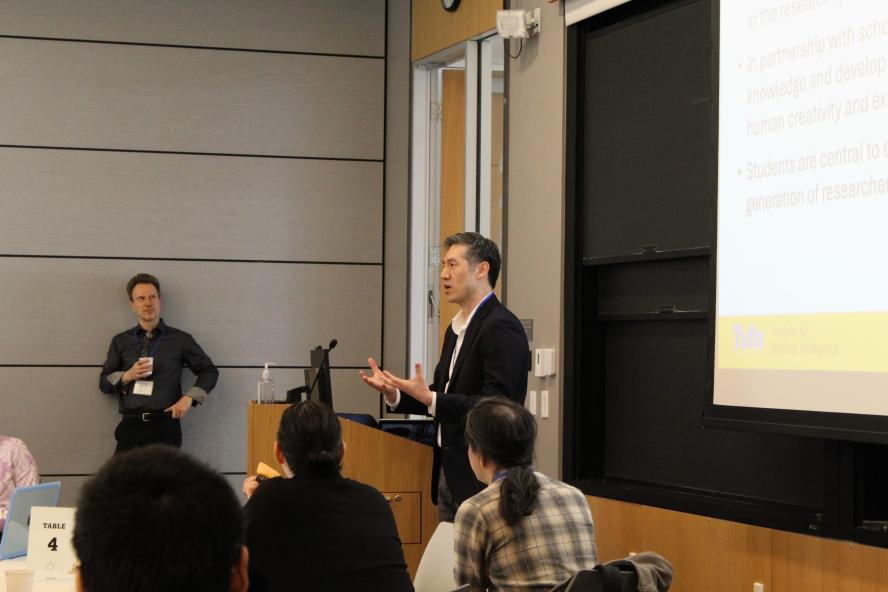
At the second annual Tufts Institute for Artificial Intelligence (TIAI) Big Ideas Day, Karol Family Professor and School of Engineering Dean Kyongbum Lee began the day by explaining the meaning of its initiative, “AI for social good.”
“TIAI embodies all our Tufts principles,” Lee said. “By applying AI in ways that can actually help people—and with an emphasis on student research involvement—TIAI will further establish Tufts as an institution committed to developing new leaders and innovating in the face of complex challenges.”
He pointed to research using AI to advance our understanding of tuberculosis treatment and to predict the onset of dental diseases before they cause harm as examples of human-centered AI scholarship.
Lee mentioned that there are many moments in history in which technology has advanced human capabilities. “All of a sudden, more knowledge becomes available to more people,” Lee said. “But what matters most is what we will do with it.”
Big Ideas Day brought together over 70 Tufts researchers on May 1 to figure out just that, learning about AI applications and limitations in various fields including language, communication, anthropology, and the environment. Diverging from last year's theme of AI and human health, the event focused discussions around AI and its interactions with humans and society, facilitating interdisciplinarity discussion of potential research ideas and collaborations that can guide the future of TIAI.
Karol Family Applied Technology Professor Matthias Scheutz of the Department of Computer Science also helped introduce the event by discussing how generative AI works. Scheutz is the director of TIAI’s Human-AI Interaction Center.
“It all boils down to one thing,” Scheutz said. “Models predicting patterns.”
For example, to form a sentence, generative AI models utilize information they’re trained on to identify patterns, predicting the probability of words that should appear next given a partial sentence. This means they use probability to make decisions about which word is most likely to come next in a given phrase or sentence, over and over, to generate an answer to a question.
“It’s a big misconception that generative AI models sometimes confabulate,” Scheutz said. “In reality, they are technically confabulating 100% of the time.”
The rest of the event consisted of 10-minute talks from faculty members across the university about how AI can be applied in different fields, followed by longer discussions among attendees to contemplate potential research questions or ideas for each subject. Scholars working in a wide range of disciplines discussed how AI can be used as a language translation tool, the ethics and philosophy of AI, how AI can affect human communication, and how AI can be used as a tool to analyze the politics of natural resource conservation and environmental sociology, and much more.
As AI rapidly accelerates discovery, facilitating interdisciplinary AI-related collaboration can help researchers address global challenges by integrating different expertise and perspectives to develop strong, well-rounded solutions.
TIAI serves as the central hub for AI research, education, and collaboration at Tufts University. Guided by the principle of social good, it is dedicated to pursuing research that has a profound, positive impact on education and learning, healthcare, ecological conservation, robotics, computing, business, creative arts, and policymaking.