Why interdisciplinary thinking is key to climate solutions

By Celine Gomes
In a world where environmental challenges are increasingly complex, the idea of “sustainability” resists a single definition. It’s a way of thinking—a method of creating solutions that account for both immediate needs and long-term consequences. As environmental challenges grow more urgent, so does the need for a new generation of innovative problem solvers. Tufts University, with its deep commitment to interdisciplinary, cross-cutting education and broad campus engagement, provides a unique environment for shaping future leaders in environmental sustainability.
At this year’s Dean’s Lecture, alumna Karin Shepardson, EG88, returned to campus to explore this very theme. Faculty, staff, students, and alumni gathered in the Tsungming Tu Complex’s Haymon Boardroom for an intimate, conversational event that encouraged candid reflection. Shepardson, who earned a joint master’s degree in civil engineering and urban and environmental policy at Tufts, is now a seasoned environmental specialist at the World Bank. She shared how her early training at Tufts laid the foundation for a global career focused on climate resilience, air pollution, and green transitions in the Global South.
The discussion, titled “Charting a Path from the Classroom to Global Environmental Sustainability,” spotlighted the value of interdisciplinary education in preparing students to address increasingly entangled environmental issues. Shepardson credited her Tufts education for fostering the kind of intellectual flexibility needed to succeed in the field. “It is tremendously useful to be cross-trained,” she said, “to be able to go up and down, far and wide.” Moreover, Tufts’ commitment to financial aid and scholarships “made all the difference,” she added, noting that this support enabled her to fully embrace the university’s broad academic offerings.
Shepardson defined sustainability as both “making things last” and “the prevention of reversal”—a definition grounded in resilience and long-term thinking. She emphasized the need to acknowledge trade-offs, work across sectors, and pursue integrated solutions that reflect the interconnected nature of climate, energy, and equity issues. “The world’s environmental issues are intersecting and always have been,” she said.
Shepardson also discussed some of her recent work, including a major initiative to address air quality in South Asia—one of the most polluted regions in the world. While the scale of such challenges might seem overwhelming, she emphasized that many of them are “very solvable.” The key, she said, lies in approaching problems through multiple lenses and remaining flexible. Her message to students was clear and urgent: “We need you not only to find new solutions, but to examine existing ones and ask what needs to change.”
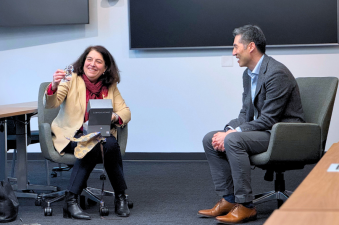
The evening concluded with remarks from Kyongbum Lee, Dean of the Tufts School of Engineering and Karol Family Professor, who thanked Shepardson for her leadership and her ongoing contributions to sustainability at the global level. As a parting gesture, he presented her with a crystal elephant, a symbolic nod to her Tufts Jumbo legacy.
Each year, the Dean’s Lecture series brings distinguished speakers to campus to share insights on pressing global challenges. Past lectures have explored themes in sustainability, from the role of building design in advancing the clean energy transition to improving batteries as a sustainable energy source.
From campus operations to classrooms and research labs, sustainability at Tufts is a collective effort spanning departments and offices across all campuses in Boston, Grafton, and Medford/Somerville. Events like the Dean’s Lecture reinforce the university’s commitment to equipping students with the tools, knowledge, and perspective to lead change—locally and globally.
Learn more about SOE’s Dean’s Lecture Series.
Department:
Civil and Environmental Engineering