Reinventing an Industry: From eReaders to Sustainable AI Displays
From digital billboards to e-readers and tablets, LCD screens are everywhere. Some stores even use tiny LCD screens to display price tags on the shelves. These screens reduce paper waste and can be updated more easily than their paper counterparts, but they typically consume a lot of power. Starting in the mid-2000s, Taiwanese company E Ink pioneered ultra-low power, paper-like LCD screens that consume minimal energy.
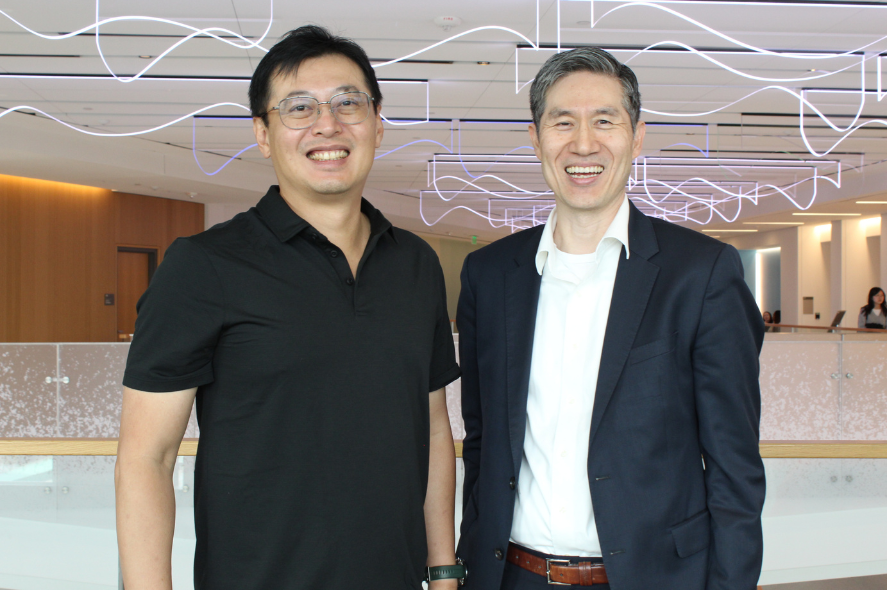
Tufts alumnus Johnson Lee, A98, has been instrumental in the spread of E Ink technology. When he joined E Ink Holdings Inc. in 2006 as the Director of Research and Development of ePaper Systems, the company was focused on the newly emerging e-reader market. Since then, he’s steered E Ink through the growth of e-readers, competition from other companies, technological innovation, and strategic shifts. Now the CEO of E Ink, he returned to Tufts to deliver the 14th Dean’s Lecture titled, “Reinventing an Industry: From e-Readers to Sustainable AI Displays,” where he discussed the ups and downs that come with running a major technology business.
Lee knows how to stay agile to keep his business competitive. His honest discussion about the constant changes that come with running a large business like E Ink demonstrated how effective leaders go with the flow and make tough decisions. Whether attendees had an interest in technology, business, or another domain, his lecture highlighted leadership qualities that students can follow in their own careers.
Some of Lee’s most unusual business decisions have turned out to be the most successful. Despite their prominent role in the market, E Ink exited the LCD business and began licensing its technology and selling materials to their competitors. “We felt that in the long run, it’s better because none of our customers want a single supplier. Buyers feel more comfortable with multiple options,” Lee said. “If there’s no competition, we’re going to create it ourselves.” The risk paid off and E Ink has since generated over $1 billion USD in licensing revenue.
Today, the company is one of the top 20 companies in Taiwan by market value with a market capitalization of $10 billion. It has earned extensive recognition for its sustainable practices including being named to the Dow Jones Sustainability World Index (DJSI-World) and the Dow Jones Sustainability Emerging Markets Index (DJSI-Emerging Markets). In 2025 E Ink received a score of 93 out of 100 in the S&P Global Corporate Sustainability Assessment (CSA).
E Ink continues to invest in research and development, resulting in some creative applications for its LCD screen technology. Picture guitars with LCD screen skins that can be changed mid-performance. Or paper-like cordless digital photo frames that can display new photos with the touch of a button. E Ink has even created a color-changing car with an LCD screen coating on the outside.
Lee wrapped up his lecture with a look into E Ink’s current priorities. He discussed how E Ink is applying its longstanding expertise in low-power technology and sustainable business practices to the new age of AI. “Energy is the new bottleneck in AI,” observed Lee. With AI data centers consuming massive amounts of energy, E Ink is turning their attention to how they can help alleviate these demands.
At the end of the lecture, the Karol Family Professor and Dean of the Tufts School of Engineering Kyongbum Lee gifted Johnson Lee with an artisan cutting board handcrafted by Tufts students in the Nolop FAST Facility makerspace. Tufts community members continued the conversation with Johnson Lee during a reception in Joyce Cummings Center.
This year’s Dean’s Lecture continued the series’ focus on sustainability, building on previous lectures about the clean energy transition and electric vehicle battery technology. The lecture is sponsored by the School of Engineering Dean’s Office and invites a prominent guest to campus on behalf of the Dean.
Department:
Biomedical Engineering , Chemical and Biological Engineering , Civil and Environmental Engineering , Computer Science , Electrical and Computer Engineering , Mechanical Engineering