Using the “Footprints” of Sound Waves to Study Saturn and the Solar System

Other planets in the solar system and throughout the galaxy—despite how far away and different they are from Earth—can actually tell us a lot about the planet we call home. For instance, studying Venus’s atmosphere helped scientists discover the science behind the greenhouse gas abundance that makes the planet so hot, serving as a cautionary tale for Earth. But information about planetary atmospheres, particularly for Saturn and Uranus, is limited because of the challenges that often come with collecting data in harsh conditions, hundreds of millions of miles away.
A team of researchers including Tufts Ph.D. student Rishabh Chaudhary and Associate Professor Robert White developed a technique that can measure the composition of the gases in Saturn’s atmosphere using ultrasound waves. Their work could make it easier to capture data crucial to understanding the climate and formation of the planets in the solar system. The Tufts pair, collaborating with colleagues Don Banfield from NASA Ames and Andi Petculescu at the University of Louisiana, recently quantified the accuracy of their instrument in a study published in Applied Physics Letters, and discussed how it could also be used to study the atmospheres of other planets.
Planetary atmospheres as planetary history lessons
As a gas giant, Saturn’s atmosphere is made up of mostly hydrogen and helium gas. These types of planets, which also include Jupiter, Uranus, and Neptune, had a significant impact on our Solar System’s formation and evolution. Their atmospheres act as signatures of formation processes that happened billions of years ago, and also give insight into active formation processes. For example, sulfur dioxide in the upper atmosphere of Earth or Venus could signify a volcano eruption. All this information helps scientists understand how the planets and their atmospheres behave, and how they, and the whole solar system, originally formed.
Saturn’s atmosphere contains different forms of hydrogen—called “ortho” and “para”—which each differ in the way their nuclei spin. The ortho-para ratio can affect Saturn’s heat cycle and offers key information about atmospheric physics and chemistry for Saturn and the solar system as a whole. Chaudhary and White’s instrument is the first of its kind that can distinguish between the different types of hydrogen, offering a powerful tool that could lead to new insights about planetary atmospheres.
“Saturn's hydrogen cycle could in some ways be thought of as similar to Earth’s water cycle,” explained White. “Like the water cycle, the ortho-para ratio is always changing and driving atmospheric conditions. Better understanding the ratio, along with helium abundance, can help us understand Saturn’s atmospheric structure and dynamics.”
The power of sound wave “footprints”
This technique works by generating sound waves at high frequencies up to the Mega-Hertz range. As the waves travel through a mixture of helium and ortho/para hydrogen, both the wave speed (or speed of sound) and the acoustic absorption (which affects the loudness) change depending on the gas mixtures they interact with. For instance, the speed of sound in ortho-hydrogen would be different from the speed of sound in para-hydrogen or helium. With this information, the team can work backwards to figure out the gas composition.
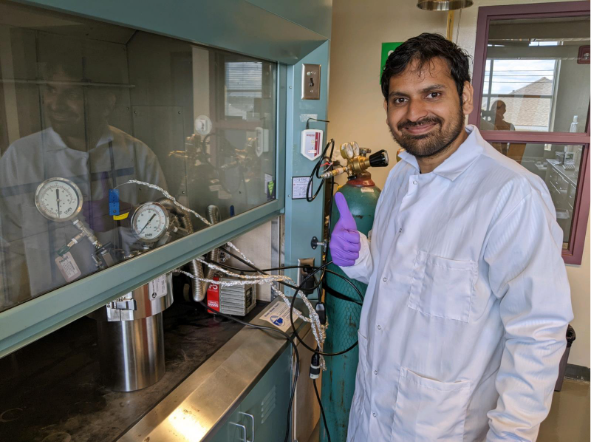
The team experimentally investigated the accuracy of the instrument in known mixtures of helium and hydrogen, finding that the instrument could measure the gases with a high level of accuracy. Based on these measurements, they did a computational study to show how accurately the instrument would measure gases if operating under the conditions found in Saturn’s atmosphere. They also found that higher operating frequencies led to more precise results.
“Not only did we find our results to be significantly accurate, but the instrument itself is lighter, lower power, faster, and able to measure what other instruments cannot: the ortho-para hydrogen ratio,” said Chaudhary. “The ortho-para hydrogen ratio is a missing piece of the puzzle when it comes to understanding Saturn’s atmosphere, heat transport, and vertical mixing—all information that could help us better understand the theories of planetary formation and evolution.”
Paving a new scientific path
Showing that the instrument works is only half the battle; demonstrating its practicality in extreme conditions could help bring the instrument one step closer to reaching Saturn’s atmosphere. The next step is to create new prototypes and test how they function while falling through Earth’s atmosphere, with some similarities to how it would be functioning while collecting data on Saturn.
The sound waves at the heart of the instrument could also help pave a new path for how scientists study the atmosphere of other planets, as the sound waves act uniquely when interacting with different gases in any environment. This means the new method could help measure, perhaps, ozone in Earth’s stratosphere, or sulfur dioxide in Venus’s upper atmosphere. By providing easier access to atmospheric data, the team’s instrument could help unlock the many mysteries that live within our solar system.
White is the PI of the Tufts Sensors and Systems Lab, in which he leads research to build hydrophones, instruments that measure wind on Mars, and more. Learn more about the lab’s work.
Department:
Mechanical Engineering