Building a Future in Offshore Wind
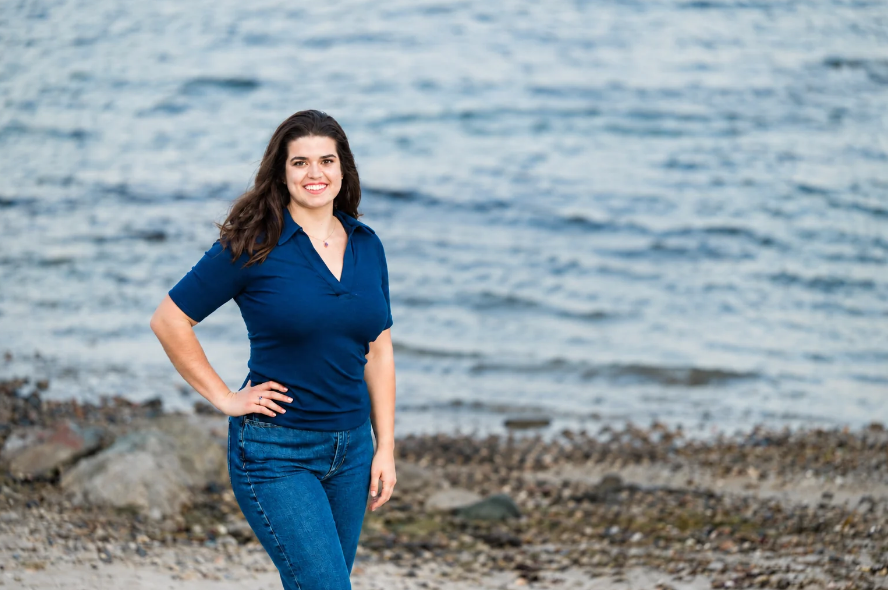
A class trip to the Marine Commerce Terminal in New Bedford during offshore wind project marshalling gave master’s student Kaitlyn Fucillo a new perspective on the offshore wind industry. “You can do all these calculations and know that a turbine is over 260 meters tall, but then you actually see it, and you gain a whole new perspective and appreciation for the turbines. It's definitely an aha moment.”

These kinds of firsthand learning experiences are a central part of the offshore wind energy engineering program at Tufts, where Fucillo is a master’s student. Faculty members, many of whom come from industry backgrounds, regularly include students in site visits or networking opportunities. “What makes the program especially unique is that a lot of the professors are professors of the practice, or they bring in people from the outside,” said Fucillo. These real-world perspectives help students stay on the cutting-edge of a field that’s constantly evolving.
The visit was part of a Ports and Supply Chains class, and students got to see how turbine parts are transported and assembled. “It's like a big Jenga game when they were trying to put it onto the boat to take out to the site because you have to put everything in a certain way in order for everything to fit,” Fucillo explained.
In addition to site visits, faculty members use their connections to help students to network. “All of my professors have been fantastic,” said Fucillo. “They not only have a big network of people outside of the university and a diverse range of experiences, but they also genuinely want to see you succeed. Through these connections, I have been fortunate enough to meet professionals spanning from Representative Patricia Haddad, who spoke about how her perspective and support surrounding local energy changed from coal to wind, all the way to Hannes Pfeiffenberger from the Brattle Group, who is one of the national leaders on transmission for the energy transition. I’ve also met recent graduates who shared their experience in industry after graduation, and advice regarding the application process.”
Offshore Wind and More
With undergraduate degrees in ocean engineering and marine biology from the University of Rhode Island, the Tufts master’s program has expanded Fucillo’s expertise to new areas. “Tufts has helped with interdisciplinary training and finding the intersection of all the areas that I’m passionate about,” she said.
The program focuses on more than just offshore wind; students examine energy systems and energy markets as a whole. “Even though offshore wind sounds really niche, it's a very interdisciplinary and broad degree. I've been taking classes at Fletcher, so I have some policy and market background in addition to my classes in the electrical engineering and civil departments,” Fucillo said. Tufts’ wide-ranging expertise makes it possible for students to explore offshore wind from many different angles.
One area that has captured Fucillo’s attention is the energy market. As energy prices soar, she and her classmates worked on a paper exploring why Massachusetts electricity prices are so high. “We examined Massachusetts’ utilities and electricity market structure, then compared electricity prices in the state with those across the United States, as well as in Denmark and the United Kingdom, where renewable energy plays a major role. We wanted to understand what drives those costs: Is it renewable energy? The investments needed to support it? Or is the problem rooted more deeply in the structure of the system as a whole?” While working on the paper, Fucillo began to see a future for herself in the energy sector.
Studying Offshore Wind Energy Engineering at Tufts
The Department of Civil and Environmental Engineering offers a full range of graduate programming in offshore wind, including a post-baccalaureate certificate, a master’s degree, and a Ph.D. program. Prospective students can visit offshorewind.tufts.edu to learn more.
According to Fucillo, pursuing a master’s degree has helped prepare her for the workforce. “The program has definitely made me a better critical thinker. When I enter the workforce, I’ll be able to apply what I’ve learned in my master’s program to real-life problems and communicate effectively with professionals from many different backgrounds.”
Learn more about Offshore Wind Energy Engineering at Tufts.
Department:
Civil and Environmental Engineering